
When you come across an old poster at a flea market, the word that comes to mind is never “advertising.” You read “advertisement,” sometimes “announcement,” or even “public notice.” These terms are not just outdated synonyms: they reflect practices, media, and commercial intentions very different from what we call advertising today.
Commercial propaganda: the forgotten term from catalogs and mail-order sales
Most narratives about the history of advertising jump directly from “advertisement” to “modern advertising.” However, there is an intermediate stage that marked decades of commercial activity in France: commercial propaganda.
Between the 1930s and 1950s, in professional circles (employers’ unions, large mail-order companies), people did not talk about “advertising campaigns” but rather “commercial propaganda.” The term referred to a set of coordinated actions to promote a product, long before the phrase “integrated communication campaign” appeared.
The semantic boundary between “propaganda” and “advertising” is much later than is usually repeated. It is associated with the decline of the word “propaganda” after World War II, when its political use rendered it toxic. To find the name of advertising from the past, one must also explore this employer vocabulary, not just illustrated posters.
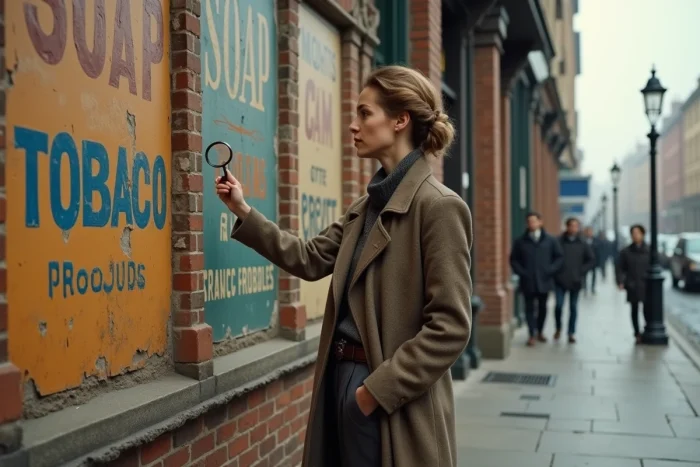
Advertisement, announcement, notice: three words for three concrete uses
We often use “advertisement” as a nostalgic catch-all. In reality, each term corresponded to a distinct medium and commercial logic.
- The announcement referred to a short, paid text inserted in the press. It was used to sell a specific item (land, furniture, service) and was similar to today’s classified ad. No visuals, no slogan: just text, a price, an address.
- The advertisement appeared as a press article written to resemble editorial content, slipped into the newspaper’s columns. The focus was on visual form and artistic impression rather than rational argumentation. It is the direct ancestor of sponsored content.
- The public notice pertained to institutional or municipal communication. It was shouted in the streets (town criers) or posted at the doors of churches and markets. Its primary function was not commercial but informative, even though merchants took advantage of it to announce their products.
This distinction shattered during the 19th century when printing allowed for the combination of text and image on colorful posters. Poster artists like Jules Chéret or Toulouse-Lautrec in Paris blurred the boundary between advertisement and art, creating a hybrid object that society no longer knew how to name with a single word.
The shift to “advertising” in France
The word “advertising” had existed in French since the 1630s, but it then referred to the public nature of a legal act (the “publicity of debates”). Its shift to a commercial meaning occurred gradually in the 19th century as the press became a full-fledged advertising market.
The influence of American terminology also accelerated this shift. Across the Atlantic, “advertising” (paid commercial announcement) and “publicity/public relations” (opinion management) were distinguished. The importation of this framework into France, particularly during the interwar period, prompted professionals to adopt “advertising” as a generic term encompassing all forms of commercial promotion.
Advertising posters and nostalgia for advertisements: a current marketing lever
One might think that these old terms only interest historians. Brands prove otherwise.
Since the early 2000s, several brands (Coca-Cola, biscuit brands, “old-fashioned” food products) have deliberately reactivated the word “advertisement” and the visual style of early 20th-century advertising posters in their campaigns. The goal is not documentary: it is a lever of advertising nostalgia, analyzed by neuromarketing researchers as a means of emotional attachment.

In practice, this approach can be found across various media:
- Retro packaging with “advertisement-style” typography and saturated colors (red, yellow, navy blue)
- Limited edition posters reproducing the lithographic style of the 19th century
- Video spots parodying early cinema advertisements, with film grain and emphatic voice-over
This recycling works because the word “advertisement” activates a specific imagery: that of an era when promotion was artisanal, local, almost naive. In contrast, “advertising” evokes strategy, targeting, data. The choice of the old word becomes a marketing tool in itself.
Advertising vocabulary and the evolution of the French market
The transition from advertisement to advertising is not just a matter of dictionary definitions. It reflects a transformation of the market and French society.
As long as promotion remained a matter for printers and town criers, the vocabulary remained fragmented: announcement, advertisement, notice, spiel. The industrialization of the press, followed by the arrival of radio and cinema, imposed a new profession (the advertising agent, ancestor of the advertiser) and a single word to designate it.
Opinions vary on the exact moment when “advertising” definitively replaced “advertisement” in common usage. What can be observed is that professional manuals from the 1960s in France almost exclusively use “advertising,” while “advertisement” persists in popular language until the 1970s-1980s, especially among generations born before the war.
The word we use to describe a commercial practice is never neutral. Each term carries its era, its media, and its power dynamics between seller and buyer. The next time a brand brings back the word “advertisement” on a package, the mechanism is transparent: yesterday’s vocabulary is used to trigger emotional attachment, while the dissemination strategy remains that of today.