A knife that cuts poorly, a pan that sticks, approximate cooking due to a lack of a probe thermometer: most home kitchens suffer from a lack of precision tools, not a shortage of recipes. Equipping your kitchen like a chef doesn’t mean stacking professional equipment, but rather selecting a few pieces whose technical quality truly changes the result on the plate.
Probe thermometers and precision scales: the foundation that consumer products overlook
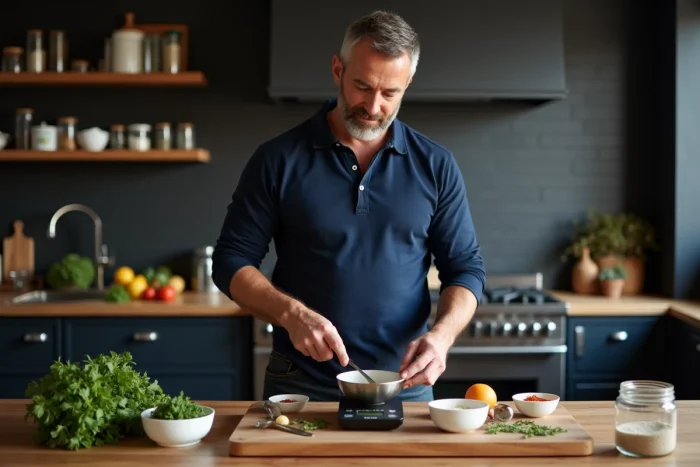
Cooking to the core is the most underestimated skill in home cooking. Without a probe thermometer, a roast veal oscillates between overcooked and accidentally pink. Schools like École Ducasse now incorporate core temperature measurement and exact weighing into their training for individuals, because culinary precision first relies on the measuring instrument.
In recent years, sales of cooking probe thermometers and precision scales have been rising sharply on online marketplaces. The reason lies in three booming practices: low-temperature cooking, homemade sourdough bread, and pastry where every gram of flour or butter alters the final texture.
We recommend choosing an instant-read probe thermometer (response time under three seconds) rather than a wired probe model, which is bulkier and often reserved for the oven. For the scale, a wide platform and precision to the gram are sufficient to cover nearly all uses, from pastry to spice measuring. You can discover the equipment on 75cl to compare ranges suitable for regular home use.
Kitchen knives: three blades replace an entire collection
A chef’s knife, a paring knife, and a slicer cover more than nine out of ten tasks in the kitchen. Accumulating specialized blades (bread knife, santoku, boning knife) only makes sense if you perform those cuts several times a week.
Carbon steel, stainless steel, or Japanese steel
The choice of steel determines the frequency of sharpening and the behavior against the acidity of foods. Carbon steel takes a formidable edge but oxidizes when in contact with lemon or tomato if the blade is not wiped immediately. Stainless steel is more forgiving for daily use without obsessive maintenance.
Japanese blades (like VG-10 or AUS-10) offer a sharper sharpening angle, around 15 degrees per side compared to 20 for classic European cutlery. This gain in finesse comes at the cost of increased fragility: a bone or a frozen root vegetable can chip the blade. Choose based on what you actually cook, not the aesthetics of the handle.
Maintenance: the sharpening stone changes everything
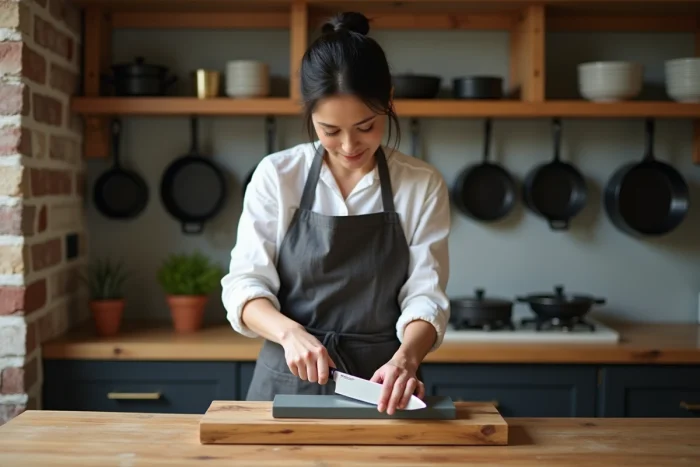
A honing steel straightens the edge between uses. It does not replace a double-grit water stone (a medium grit to reshape the edge, a fine grit to polish it). Spending five minutes on a stone every two to three weeks keeps a chef’s knife in a condition that most amateur cooks have never experienced.
Pans and cooking: the material dictates the technique
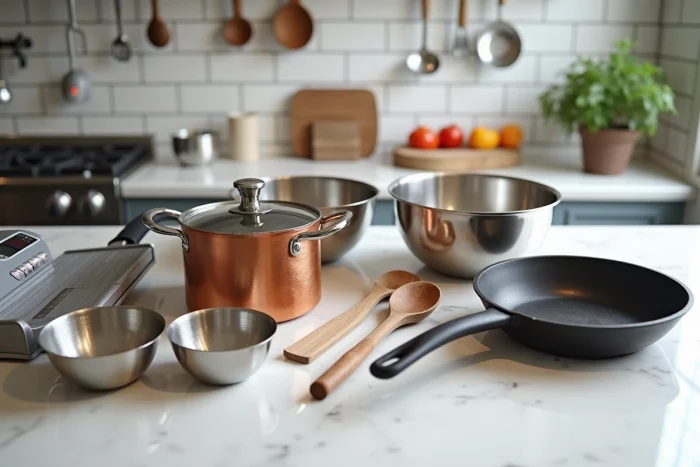
A stainless steel pan is not used the same way as a cast iron pan or a non-stick coating. Trying to do everything with a single pan means accepting compromises on every dish.
- Thick stainless steel (triple or five layers with an aluminum core) excels for high-temperature searing and deglazing. It requires proper preheating and sufficient fat to avoid sticking.
- Raw cast iron retains heat and distributes it evenly, ideal for long cooking, gratins, or bread in a Dutch oven. Its weight and heating time make it unsuitable for quick stir-fries.
- The non-stick coating remains the rational choice for eggs, pancakes, and delicate fish. Replace it as soon as the coating shows visible scratches, because a degraded surface loses precisely the property for which you bought it.
With these three types of pans, you cover nearly all domestic cooking techniques without unnecessary duplication.
Accessories from professional kitchens and dark kitchens
Dark kitchens have popularized a minimalist yet ultra-functional approach to equipment: every tool must save measurable time or disappear from the countertop. Several of these accessories find a direct place in a kitchen oriented towards batch cooking or meal prep.
- Squeeze bottles allow for dosing sauces and oils with a consistency impossible to achieve with a spoon. They cost a few euros and transform plating.
- A grid vegetable cutter (like a fry press) speeds up the cutting of potatoes, carrots, and zucchini for oven cooking or stir-fries. The time saved compared to a knife is significant when cooking for four people.
- Color-coded cutting boards (one for raw meat, one for vegetables, one for fish) transpose the HACCP principle of separating areas to avoid cross-contamination. Adopting this logic reduces health risks without any heavy investment.
Cutting boards and hygiene: a neglected angle in home cooking
HACCP standards impose strict separation in professional catering between surfaces that come into contact with raw products and those reserved for ready-to-eat products. At home, most cooks use a single board for everything, from raw chicken to fresh herbs.
Hardwoods (maple, beech) offer natural antibacterial properties as long as they are regularly oiled. Polypropylene withstands the dishwasher and is easily replaced when the cuts become too deep to clean properly. We observe that two distinct boards are sufficient to secure most preparations: one reserved for raw proteins, the other for everything else.
Equipping a high-performing kitchen ultimately comes down to a handful of well-placed technical choices: reliable measuring instruments, knives maintained on a stone, pans chosen by material rather than brand, and a few accessories borrowed from professionals. The rest is about technique, not the catalog.