
We receive a bank account details (RIB) by email, we copy the IBAN to set up a transfer, and we come across this string of characters that starts with FR76. The temptation is strong to believe that “FR76” designates a specific bank or a particular type of account. In practice, this prefix appears on the vast majority of French IBANs, and its meaning is both simpler and more technical than one might think.
FR76 in a French IBAN: why this prefix appears everywhere
When looking at a French IBAN, the first two letters (FR) indicate the country. The two digits that follow form the IBAN control key, calculated according to an international algorithm (ISO standard 7064). This key is used to verify that the IBAN has not been incorrectly copied or truncated.
For French accounts where the account number (the BBAN) consists solely of digits, the result of the calculation for this key systematically yields 76. This is a mathematical consequence, not an administrative choice. FR76 does not identify the bank, the branch, or the type of account: it simply indicates a French IBAN with a fully numeric BBAN.
Thus, one can have an IBAN starting with FR76 at Crédit Agricole, La Banque Postale, LCL, or in a neobank. If the BBAN contains a letter (which happens with certain savings accounts or passbooks), the IBAN key changes, and the prefix will no longer be FR76. To understand the bank code FR76 in detail, it is important to remember that “76” is a format indicator, not a banking affiliation.
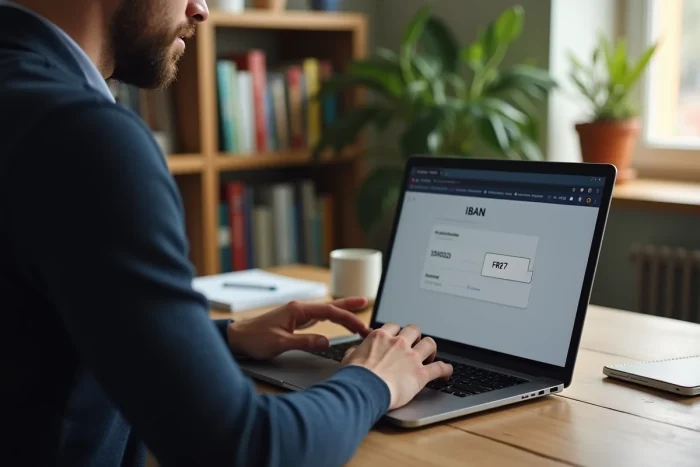
Locating the bank code in an IBAN: the exact positions to know
The most common confusion is to equate FR76 with the bank code. In reality, the bank code is located just after this prefix. A French IBAN is always broken down in the same order:
- Characters 1-2: country code (FR)
- Characters 3-4: IBAN control key (76 in most cases)
- Characters 5-9: 5-digit bank code, assigned by the Banque de France to each institution
- Characters 10-14: branch code (5 digits), identifying the agency
- Characters 15-25: account number (11 characters)
- Characters 26-27: RIB key (2 digits)
Specifically, if we take an IBAN that starts with FR76 30002, the bank code is 30002 (that of LCL). This position is standardized and never varies, regardless of the bank or IBAN key.
Quick check on a paper RIB
On a classic RIB, the bank code is usually displayed in a separate box, labeled “Bank Code” or “Bank”. There is no need to dissect the IBAN. However, when we only receive an IBAN (by message or on an invoice), counting from the fifth character remains the most reliable method to isolate the bank code.
Common banking operations: what FR76 changes (or not) in practice
For a standard SEPA transfer between two French accounts, we enter the complete IBAN of the beneficiary. The prefix FR76 is automatically processed by the banking system, which extracts the bank code and branch code to route the payment. There is nothing we need to do manually with these blocks of numbers.
The point where it gets tricky in practice is the entry. An error on a single character of the IBAN causes a rejection because the control key no longer matches. This is precisely the role of “76” (or another key): to detect transcription errors before the transfer is initiated.
International transfers and BIC code
For transfers outside the SEPA zone, the BIC code (also known as SWIFT) comes into play. The BIC identifies the bank globally with 8 or 11 characters. The prefix FR76 plays no role in this circuit: it is the BIC that takes over to route the funds to the correct institution abroad.
For intra-SEPA transfers (the vast majority of operations in Europe), the BIC has not been mandatory for several years. The IBAN alone is sufficient, and the system deduces the recipient institution from the bank code embedded in the IBAN.
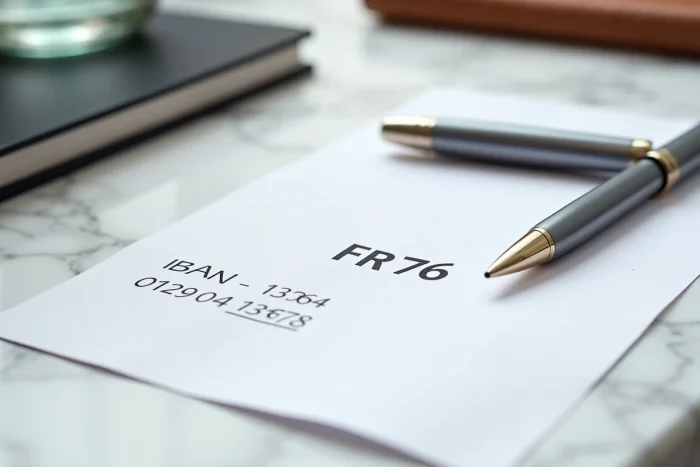
IBANs that do not start with FR76: special cases to identify
Not all French IBANs begin with FR76. When the BBAN contains at least one alphabetical character, the calculation of the control key produces a different result. This situation occurs with certain regulated passbooks or special accounts whose number includes a letter.
The difference has no impact on the validity of the account or the operations that can be performed. An IBAN starting with FR14 or FR04 functions exactly the same way as a FR76. The verification mechanism remains identical; only the result of the calculation changes.
Accounts domiciled in overseas territories
Bank accounts in overseas departments and regions also use the prefix FR, as they fall under the French banking system. The bank code and branch code allow for distinguishing the institution and agency, not the prefix FR76. Thus, the same functioning is found as in mainland France.
Ultimately, the only usable information to identify a bank from an IBAN remains the block of five digits in positions 5 to 9. The prefix FR76 confirms a standard format French IBAN, nothing more. Keeping this distinction in mind prevents searching for a hidden meaning where there is only an automatic calculation result.