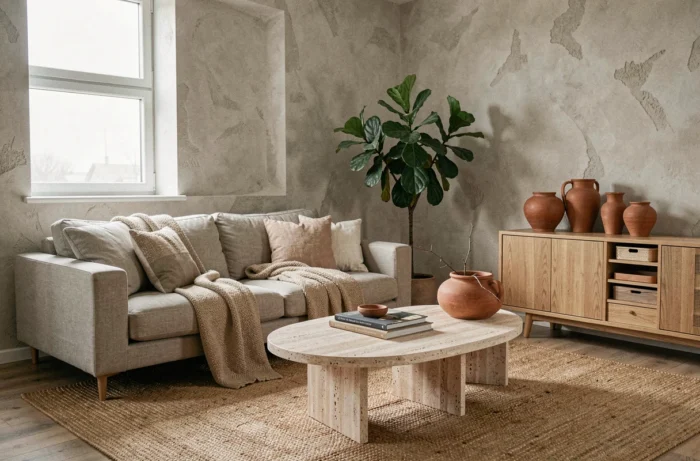
Interior decoration is at the crossroads of several changes: the gradual restriction of certain chemical substances in textiles, the rise of reuse framed by quantified objectives, and the obligation for environmental labeling on furniture products. These frameworks concretely modify the way one chooses a fabric, a piece of furniture, or a covering. Enhancing your interior with style and creativity now also involves understanding what is happening upstream of the decoration aisle.
Upholstery Textiles and PFAS: What the Regulation Changes for Your Decor Choices
PFAS, the fluorinated compounds used to make fabrics stain-resistant or water-repellent, are subject to a gradual ban in upholstery textiles. For interior decoration, this means that sofa covers, treated curtains, and certain textile wall coverings are gradually losing their historical chemical treatments.
The logical reflex is to turn to naturally resistant textiles without PFAS treatment: thick linen, twill cotton, boiled wool. These fibers provide adequate resistance to common stains without the addition of perfluorinated compounds. Their raw texture offers a visual grain that treated synthetic fabrics do not replicate.
Before purchasing upholstery fabric, checking for an explicit mention of the absence of PFAS becomes a relevant gesture. Manufacturers who anticipate the regulation indicate this on their product sheets. To deepen your material choices and find pieces consistent with this approach, catalogs like the one offered on miragedinterieur.fr allow you to cross-reference style and textile composition.
Reuse of Furniture: The Goal of 120,000 Tons by Ecomaison and Its Effects on Decor

The eco-organization Ecomaison has set a target for the recovery of 120,000 tons of items intended for reuse or repurposing by 2030, with an intermediate milestone planned for 2026. This figure directly concerns furniture: tables, chairs, dressers, lighting fixtures.
In practice, this means that an increasing volume of quality furniture is re-entering the commercial circuit after refurbishment. For those looking to furnish a living room or bedroom with character, reused furniture offers pieces that standardized new items no longer provide: cast iron bases, solid walnut veneers, original brass hardware.
Field reports vary on the accessibility of these pieces. In large metropolitan areas, recycling centers and specialized platforms offer a regular stock. In rural areas, the supply remains more dispersed. Sorting often occurs on-site, with no guarantee of finding the sought-after piece during each visit.
Criteria for Evaluating Reused Furniture Before Purchase
- Assembly: check the solidity of the mortise and tenon joints or dowels, as a piece of furniture with a wobbly structure is not worth refurbishing
- Surface finish: a veneer that is peeling at the edges can be easily repaired, while a particleboard structure swollen from moisture cannot be salvaged
- Hardware: hinges, handles, and drawer slides can be replaced, but their absence on an old piece may indicate a rough disassembly
Triman Labeling on Decoration Products: Reading Labels Differently
The Triman logo has applied to furniture products since December 15, 2022 and to textile decoration elements since August 25, 2023. This labeling indicates that the product falls within an organized sorting and recycling stream.
For interior decoration, this information has concrete utility at the time of purchase. A cushion, a throw, or a light fixture bearing the Triman logo is part of an identified end-of-life circuit. This does not guarantee that the product is eco-friendly in its manufacturing, but it means that it will not necessarily end up in a landfill.
The absence of Triman on a decoration product sold in France may indicate either a manufacturer’s non-compliance or an imported product outside the stream. In either case, it warrants a question to the seller. A decor product without Triman labeling in 2026 raises a legitimate doubt about the traceability of its stream.
Materials and Colors in Interior Decoration: Balancing Trend and Durability
Dominant palettes evolve each season, but some choices stand the test of time better than others. Walnut, light oak, and terracotta shades traverse several cycles without appearing dated. Saturated colors (sage green, petrol blue) work on easily replaceable elements: cushions, vases, wall art.
Applying a strong color to an entire wall is a bigger commitment. A living room painted in deep burgundy impresses for the first six months, then constrains all choices of furniture and textiles. Neutral shades on fixed surfaces and strong colors on movable objects represent a balance that preserves the freedom to evolve the ambiance of a room.
Combining Textures and Light in a Living Space
Natural light radically alters the perception of a material. Corduroy appears warm under evening light and almost dull under neon. Testing fabric samples in the target room at different times helps avoid disappointments after installation.
Matte materials (raw linen, polished concrete, terracotta) absorb light and create a cozy atmosphere. Reflective surfaces (brass, glass, lacquer) redistribute it and visually enlarge the space. Combining the two in the same room produces a contrast that neither generates alone.
- A mirror placed opposite a window doubles the perceived depth of a narrow living room without renovation
- A brushed brass light fixture placed on a raw wood console creates a focal point through contrasting finishes
- A jute rug under a glass table combines transparency and texture, grounding the furniture without weighing it down
The traceability of materials, structured reuse, and environmental labeling are redefining the contours of interior decoration. Choosing a textile, a piece of furniture, or a color now involves criteria that go beyond mere aesthetics. Labels, composition, and end-of-life streams are part of the decor project just as much as the palette or style.