
The plane tree mulberry grows quickly, often more than 60 cm per year. Without intervention, it quickly loses its compact shape and its shade becomes unruly. Pruning a plane tree mulberry is not just about shortening branches: it’s about directing its growth to maintain that famous parasol shape that makes it so appealing on a terrace or in a garden.
Health vigilance before pruning a plane tree mulberry
Before even taking out the secateurs, take the time to observe your tree. This reflex can help you avoid spreading a problem unknowingly.
In certain municipalities in the south of France, the plane tree mulberry is subject to phytosanitary vigilance related to the tiger longhorn beetle. Exit holes in the bark, sawdust at the base of the trunk, or visible galleries are all warning signs. If you spot these symptoms, do not prune and do not move the wood yourself. The tree must be reported to the DRAAF-SRAL for diagnosis by a qualified professional.
Work on a potentially affected tree is recommended between November and April, outside the insect’s flight period. This constraint aligns with the classic pruning calendar, simplifying planning.
Another often overlooked point: disinfect your tools between each tree. A contaminated secateur or saw can transmit pathogens from one subject to another. This action takes a few seconds (70° alcohol or diluted bleach) and limits the spread of diseases, especially if your trees are close to rows of plane trees. For further details on these precautions, you will find useful guidelines in the world of Jardiner Naturellement, which outlines good sanitary practices around this tree.
Pruning period for the plane tree mulberry: the right winter window
Have you noticed that the branches of the plane tree mulberry are completely bare in winter? This is precisely the time to aim for. Pruning takes place between December and the end of February, when the sap has descended and the structure of the tree is perfectly visible.
Pruning when there are no leaves has a tangible advantage: you can see every branch, every node, every new shoot. No leaves obscure a crossing or a dead branch. Identifying the cuts to be made becomes almost intuitive.
Why avoid pruning from March to August
The rise of sap in spring makes cuts more “bleeding”: the tree heals less well and weakens. The period from mid-March to mid-August also corresponds to the nesting of birds. Destroying a nest or eggs of protected species is prohibited year-round, even on a tree in your garden. Inspect the branches before any intervention, even in winter, as some species reuse their nests.
Cat head technique for a parasol shape
The “cat head” is the name given to the knobby swellings that form at the ends of the main branches after several years of pruning at the same point. This is not a defect: it is the desired result.
The principle is simple. Each winter, you cut the year’s shoots just above the existing swelling, leaving one to two centimeters of wood. Over the years, this cut point thickens and forms a sort of rounded stub (the “cat head”). It is from this point that new shoots will emerge in spring, in a regular and controlled manner.
Building the framework in the first years
On a young plane tree mulberry, the cat head does not yet exist. The first pruning aims to define the structure:
- Select three to five main branches well distributed around the trunk, oriented outward to form the future parasol
- Remove branches that grow inward, downward, or cross with another main branch
- Shorten each retained branch above an outward-facing bud, to the desired length for the diameter of your parasol
The first three years determine the final silhouette of the tree. Take the time to choose your main branches well: a structural error at this stage is difficult to correct later.

Annual maintenance on an established mulberry
Once the structure is in place, annual pruning is quick. Each winter, you return to cut at the level of the cat heads. The year’s shoots are soft and easy to cut with secateurs or loppers, depending on their diameter.
Take the opportunity to remove dead wood and any suckers on the trunk. These greedy shoots divert sap without contributing to the parasol. A well-maintained plane tree mulberry in this way retains a dense and uniform shape for decades.
Common mistakes that damage the plane tree mulberry
Why do some plane tree mulberries end up with a tortured appearance, hollow branches, or an unbalanced parasol? The answer often lies in a few repeated actions at the wrong place or time.
- Cutting below the cat head: you remove the regrowth point and force the tree to create new buds lower down, which disorganizes the branches
- Pruning during full vegetation, when the leaves are deployed: healing is slow, and fungi settle in the open wounds
- Using poorly sharpened tools that crush the wood instead of cutting it cleanly: a clean cut heals two to three times faster than a torn cut
- Removing all shoots from one side, which creates a mass imbalance and can weaken the tree’s anchorage against the wind
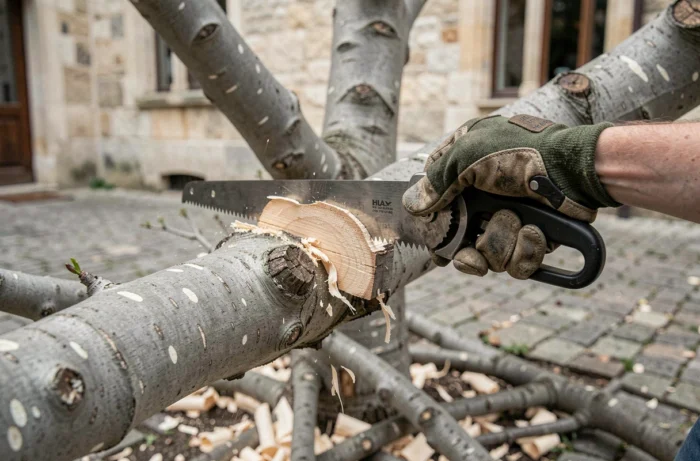
One last point rarely mentioned: never cut a thick branch in one go. The weight of the wood may cause the bark to tear downwards. First, make a notch underneath, then saw from above, a few centimeters from the trunk, before making the final cut at the collar of the branch.
The plane tree mulberry forgives many approximations due to its natural vigor. But a tree pruned cleanly, at the right time, with disinfected tools, remains healthy longer and produces a more regular parasol. The effort focuses on the first years of training: once the framework is established, annual pruning takes only half an hour.