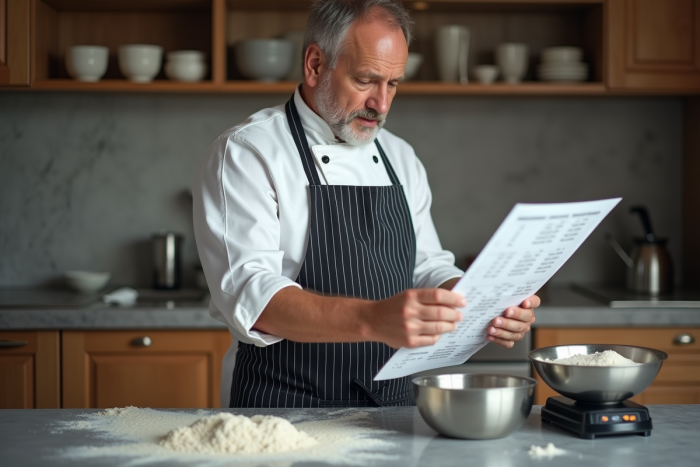
Five milliliters too much, and a sauce curdles. Five less, and the dough collapses. French recipes are written in centiliters, but supermarket utensils stubbornly stick to milliliters. Behind this seemingly harmless discrepancy lies a trap: every year, thousands of dishes fail on the altar of a careless conversion. Even seasoned cooks sometimes leave their apron behind.
Mastering conversions between milliliters and centiliters? More complicated than it seems. Just a forgotten rule or a hasty calculation can upset the balance of a dish. And uncertainty makes its way to the table.
Milliliters and centiliters: understanding the differences for precise cooking
In the kitchen, juggling with units of measurement is not just a technical detail reserved for purists. It is the foundation upon which the success of a recipe rests, from taste to texture. Ten milliliters for one centiliter, the conversion seems simple, but practice holds pitfalls, especially when moving from a professional environment to everyday cooking.
An incorrectly estimated centiliter, and the custard liquefies; a few neglected milliliters, and the cake loses its coveted softness. These mistakes do not stop with liquids: as soon as the density of an ingredient changes the game, the calculation becomes complicated. To convert, for example, 75 cl to grams, you first need to know what it is. Everything depends on the nature of the food and reliable references, like those provided in “Understanding the conversion of 75 centiliters to grams in your preparations – Pulsar News.”
Liters, centiliters, milliliters: this trio sows doubt, especially when each measuring instrument speaks a different language. Rigor in quantities shapes the balance of flavors. Too much water, and the aromas get lost; too little, and everything concentrates excessively. Making conversion a systematic step ensures consistent results, no matter the recipe. Observe how dishes change from hand to hand, from country to country, from unit to unit: the path of flavors goes through precision.

Simple daily conversions: methods, tips, and tools to never make a mistake again
Adapting measurements is a daily reflex, often invisible, but never trivial. The measuring cup, sitting on the countertop, remains the tool of choice. Its main asset? Clear references, from graduations in milliliters to indications in centiliters, even in grams for common liquids. Each ingredient has its measure, each measure has its unit.
For those who want to get straight to the point, there are mobile apps and online calculators designed to convert without hesitation. Convenient, they allow you to switch from one unit to another in seconds, whether it’s liquids or solids. Just enter the quantity, choose the starting unit and the target unit, and the result is displayed. These tools significantly reduce margins of error and make the task easier, even in the heat of the moment.
Some prefer to keep a conversion chart handy, stuck on the refrigerator or slipped into a drawer. Before detailing what it looks like, let’s recall its importance: it provides immediate support to avoid missteps, especially when the pressure rises and conversions multiply.
- 1 centiliter = 10 milliliters
- 1 liter = 100 centiliters
This discreet yet constant presence reassures and avoids the approximations that spoil the work. A quick glance is enough to clear doubts and adjust the preparation.
What makes the difference is consistency. Taking the time to check the correspondence of units, choosing the right tools, whether it’s a modern measuring cup or a reliable app, ensures that the result will be true to the promise. In cooking, precision is never negotiable. The success of a dish can sometimes hinge on ten milliliters.
In the kitchen, the rigor of conversions draws the line between approximation and excellence. With each precise gesture, the promise of a successful dish. With each approximation, the risk of disappointment. So, the next time you pour, measure, or convert, remember: behind every milliliter, there is taste, texture, and the pleasure of sharing a finished dish.