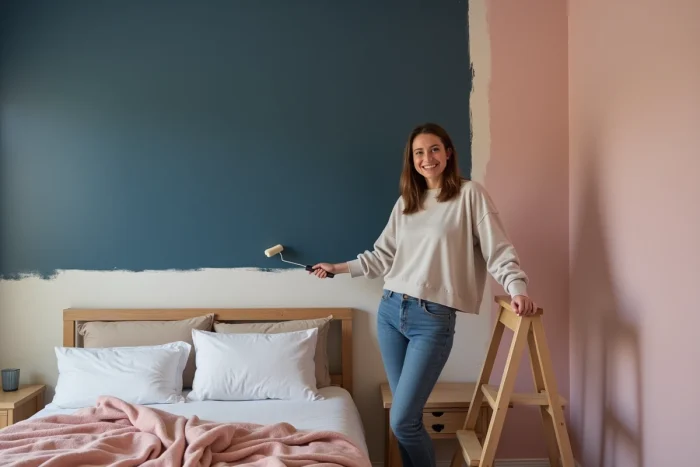
A two-tone wall does not always adhere to expected rules. The boundary plays with symmetry, tilts, hugs the contour of a piece of furniture, and disrupts codes. Two complementary shades? Balance is never guaranteed. The combination can surprise, sometimes disturb the room if light or depth have not been anticipated from the outset. Painting in two colors also means facing some technical constraints: precise marking, meticulous preparation of the surface, and vigilance regarding overflow at the corners. Some patterns, reputed to be complex, can be achieved without a full arsenal of tools. But the classic mistake? A wrong order of applying layers, and the result loses all its appeal.
Two-tone bedroom: what two-tone paint really changes in the atmosphere
Creating a two-tone bedroom is not just about juxtaposing two colors for the sake of contrast. Choosing two-tone paint structures the room, delineates areas, sometimes unsuspected in a unified bedroom. A dark accent wall behind the headboard adds depth; a light shade on the other walls keeps the light, preserving the feeling of space. Distributing colors well, balancing their intensity: these choices alter the perception and ambiance of the place.
Natural light, too often relegated to the background, amplifies or diminishes the effect of a two-tone wall. A dark tone absorbs, a light tone reflects. For a room facing north, nothing beats a warm hue, terracotta or beige, to compensate for the ambient coolness. To the south, blues and greens soften the heat. And the ceiling? Keeping it white remains a reflex: it lightens the whole, avoiding the feeling of confinement.
The relationship between two-tone paint and ambiance goes beyond the simple choice of colors. Here are some distributions to consider:
- 3 neutral walls, 1 accent wall, or a 3/4 division that invites rethinking the function of each wall.
- Placing a dark wall opposite the window reduces brightness; prefer to position it on the wall visible from the entrance or behind the headboard.
To delve deeper, ideas for a two-tone bedroom open up other perspectives for painting a room in two colors and signing a trendy ambiance, without a false note.
What colors and patterns to choose for a successful effect without a false note?
Creating a color palette for a two-tone bedroom requires method and subtlety. Two main paths are available to you: monochrome, an alliance of close shades, envelops and soothes. A duo of beige and sand, sky blue and ink blue, establishes a soft harmony, conducive to rest. The warm/cool contrast energizes the space:
- sage green and terracotta,
- midnight blue and cream,
- mustard yellow and anthracite gray.
The orientation of the bedroom guides the choice: warm shades (terracotta, beige, ochre) warm up a room facing north. Cool colors (blue, green) express themselves better in a room that is largely sunny.
The famous 3+1 rule (three neutral walls, one accent wall) ensures balanced decoration. Installing an accent wall behind the bed, highlighted by a strong color or wallpaper, draws the eye without overwhelming. Geometric patterns personalize a wall without weighing down the atmosphere. Betting on a 75/25 or 70/30 distribution between light and intense colors guarantees both light and depth.
To achieve the right match, adopt these reflexes:
- Test your colors on 50×50 cm at different times of the day: light really influences the rendering.
- Coordinate the decor accessories (cushions, curtains, rugs) with the accent color to reinforce visual coherence.
- Opt for a matte or satin finish: gloss accentuates imperfections and is not suitable for the ambiance of a bedroom.
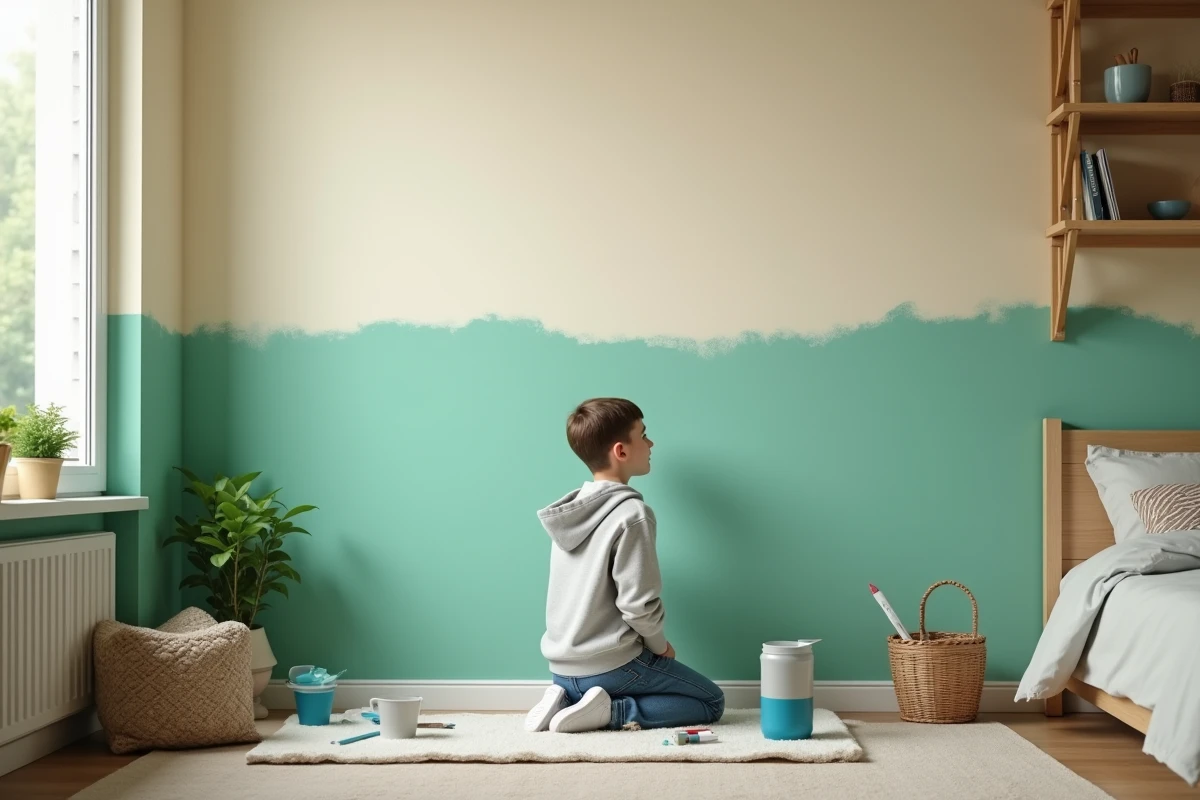
Steps and tips for painting a two-tone wall at mid-height like a pro
Preparing the site: the foundation for a clean finish
Before starting the painting, take the time to prepare the wall. Thoroughly wash the surface to remove dust and marks, fill in any imperfections, and then sand. Applying a primer harmonizes the base, especially if the new color sharply contrasts with the old one.
Marking the line: precision and method
For a two-tone wall at mid-height, the horizontal division is measured from the floor, between 1.10 m and 1.30 m. Use a level or laser to draw a perfectly straight line. Apply a quality masking tape, pressing firmly on the edges to avoid smudges.
- Start with the light shade and let it dry completely.
- Stick the tape, then apply the dark color with a roller suitable for smooth walls.
- Remove the tape while the paint is not completely dry for a precise edge.
The choice of finish depends on the use: matte absorbs light and masks small defects; satin reflects more and is easy to maintain. To create graphic effects, the masking tape allows for daring triangles, arches, or unexpected baseboards.
Recognized paint brands such as Dulux Valentine, Tollens, Sikkens, or Farrow & Ball offer coverage and durability. If the project seems complex or the finish needs to be perfect, hiring a professional painter remains an option to consider.
Daring the two-tone wall gives the bedroom a character unlike any other. A simple brush stroke, and the space takes on a new dimension: one where color no longer follows a straight line, but traces your own.